
Three Questions to Help Your Child Think Clearly
Children are told things all day long. A friend says someone cheated, or a video of a fight at school goes round the year group. Many children accept whatever they hear first, or treat a photo or video as the whole story.
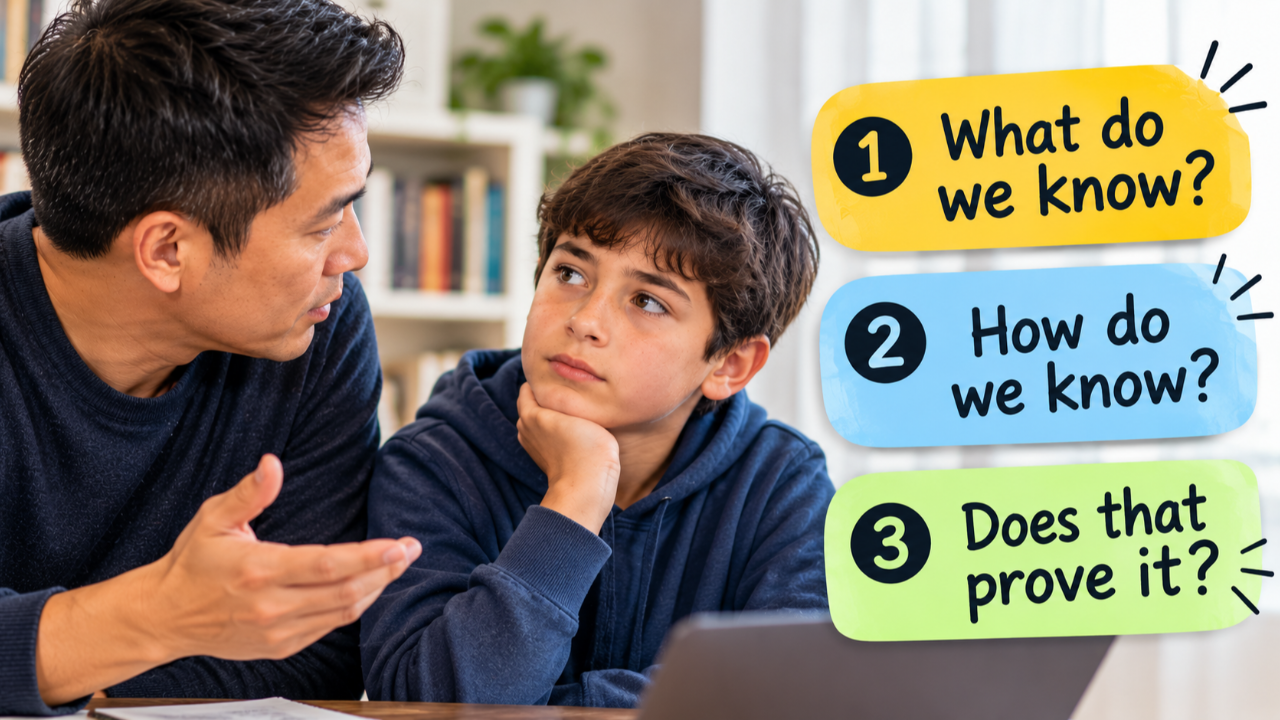
A simple habit can help. When they hear a claim, they pause and ask three questions.
1. What do we know?
Begin with the facts. Ask your child what they saw or heard, what was said, what was shown, and whether anyone has checked it.
Say your child comes home and tells you, "Tom cheated at football today." You ask what happened, and they tell you he kicked the ball after the whistle. That is something we can check. Did Tom hear the whistle? Had play stopped? Did the other kids see it the same way?
Encourage your child to keep to what they know and to leave out anything they didn't see or hear themselves.
This is also a good way to teach the difference between fact and opinion. "Tom kicked the ball after the whistle" describes what happened. "Tom cheated" is a judgement about what happened and why he did it. The first can be true while the second is wrong.
2. How do we know?
Next, look at where the information came from. Did your child see it themselves, did someone tell them, was there a video, or did they read it online? These sources give different levels of proof. A child who watched the incident knows what they saw. A child who heard it from a friend has second-hand news. A video may show one part of an event and leave out what came before and after.
Some useful questions are: Who told you? Did they see it themselves? Could they be wrong? Is there a way to check?
Several people telling the same story do not add up to several sources. Five kids may all say the same thing, but if they all heard it from one child, there may be only one first-hand account. Online it works the same way. Many sites can repeat a single claim without any of them having checked it.
3. Does that prove it?
Here we look at what the facts can tell us. A fact can be true and still not prove the claim attached to it.
Suppose your child finds a broken window and says, "Jack broke it." The window tells us that something happened. It doesn't tell us who did it. Did anyone see Jack throw a ball? Is there a video? Did Jack say he did it? Each new piece of evidence helps us work out what took place, and it's still worth asking whether something else could have caused it.
Base rates
A base rate is how often something happens. Your child might say, "Every time I wear my blue socks, our team wins." You could ask how many times they've worn the socks and lost, and how often the team wins when they wear other socks. Children tend to remember the wins and forget the losses, so they see a link that isn't there. One case can look like a pattern. It's worth asking how often it happens, and whether we've looked at all the cases or only the ones that fit.
The same thinking applies to claims about other people. Does someone being angry prove they meant to hurt anyone? Does a poor mark prove a child didn't study? Does staying home from school prove someone is dodging work? The facts may support a claim without proving it.
Use the same test on everyone
Children should learn that the same rules apply to people they like and people they don't. If their best friend tells them a story, ask how they know. If someone they dislike makes a claim, check the facts there too. The same goes for what a teacher, a parent, a news site or a public body says.
Reports often mix facts, witness accounts, rough counts, claims, opinions and final judgements. Some parts are well supported, and others depend on how the writer reads the facts. Writers have their own views and biases. That doesn't make them wrong, but it does give us reason to look at their sources and at how they reached their conclusions. Children can ask what was seen, what was checked, what the writer inferred, and whether the evidence supports the claim. If new facts come to light, they should be ready to change their mind.
A simple habit
Next time your child tells you something has happened, try asking: What do we know? How do we know? Does that prove it?
You don't need to turn every chat into a lesson. Save the questions for claims that are worth checking.
